Ten Plumbing Terms Everyone Should Know

Plumbers working on pipes under sink

You don’t have to be a plumbing expert, but knowing a few simple plumbing terms will help you explain your plumbing problems to your service technician accurately. Knowing just a few key terms will prepare you for communicating with whoever is taking your call or showing up at your door for plumbing repairs.

  1. Grey Water
    This is the used water that drains away from your showers, bathtubs, and sinks after you wash your hands, do dishes, or take a shower. If the water is flushed from the toilet to the sewer, that is called “black water.”
  2. Flapper Valve
    A flapper is the rubber flap at the bottom of your toilet tank that opens to allow water from the tank to fill up the bowl when you flush.
  3. Shut Off Valve/Main Shut Off Valve
    Shut-offs are the stops under the sinks and behind the toilets in your home that allow you to shut off the water locally. Plumbers sometimes call them angle stops.

    Everyone should also know what their main shut-off valve looks like and how to turn it off in case of a water emergency like a major leak. The main shut-off is usually found in the basement or crawl space and allows you to shut off the water coming into the whole home from your main water line.
  4. O-Ring
    An o-ring is simply a circular-shaped, rubber washer that ensures water-tight seals.
  5. Pressure Reducing Valve
    A PRV, or Pressure Reducing Valve, is a device that stabilizes the water pressure in your home or business to a level between 50 and 80 psi (pounds per square inch) to prevent damage to ensure adequate water pressure that is safe for your plumbing appliances, fixtures, and pipes.
  6. Hose Bib
    A hose bib is simply the plumber’s term for your outside hose spigot.
  7. P-Trap
    This is exactly what it says it is…a P-shaped piece of piping underneath sinks that allows for a pool of water to collect in the pipe to seal the drain. This prevents bad smells and back-ups and is imperative to any drain.
  8. Water Hammer
    This is a sound that occurs when pressurized water inside a pipe suddenly reverses direction which can happen when you open or close a faucet.
  9. Auger or Cable Machine
    An Auger is a coiled cable that, when fed down into a clogged pipe as far as it will go and turning a crank, will eat its way through an obstruction in the pipe. A Cable Machine is similar but has a motor to turn the cable against the obstruction.
  10. Vent Stack
    The vent stack is the main vent pipe connecting the main sewer line to the roof in order to dissipate harmful gasses and allow air into the pipes to equalize pressure.

BACKFLOW PREVENTION SPOTLIGHT

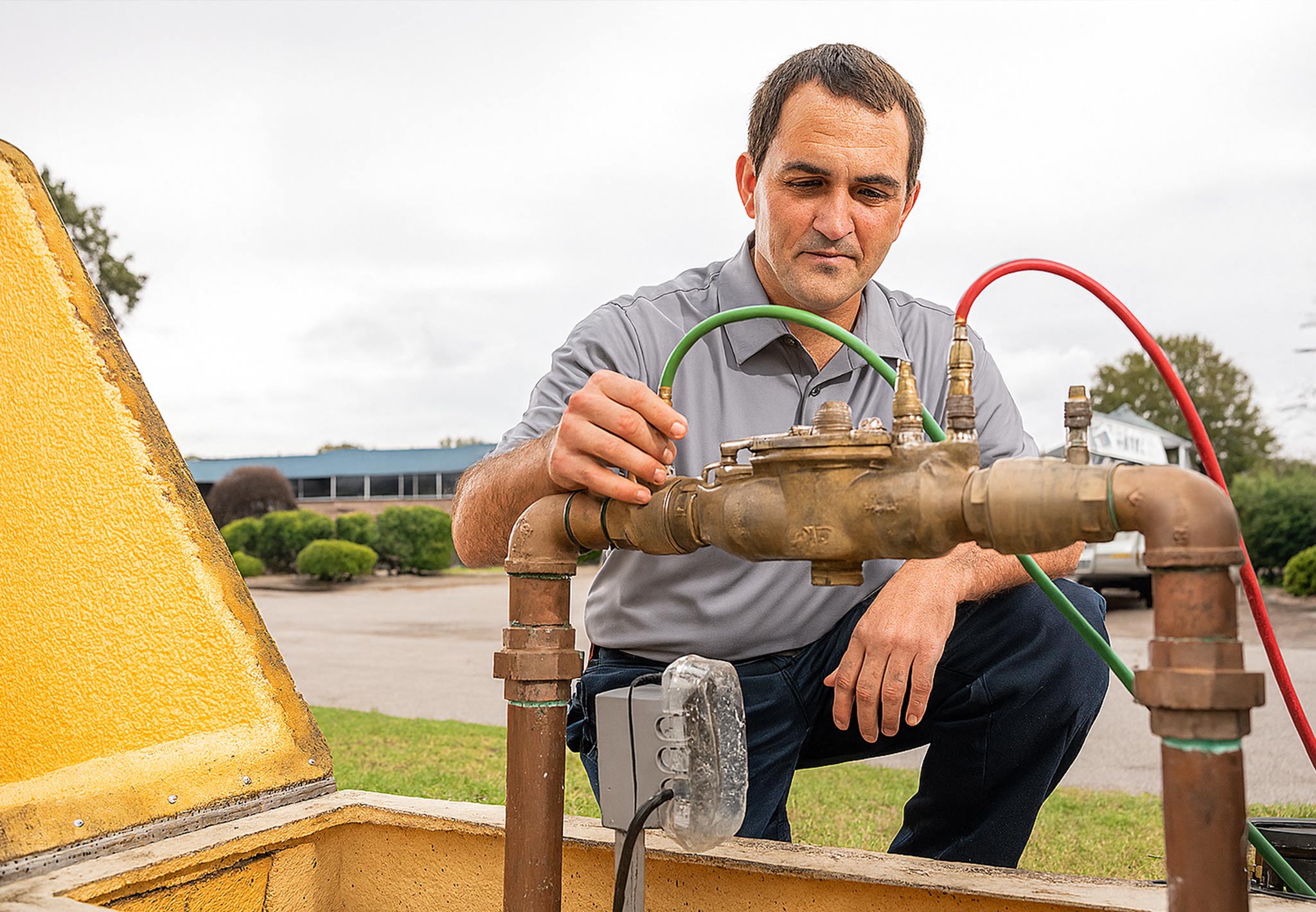
inspecting backflow prevention device

It is springtime here in the Midwest and it’s also about that time to turn on your lawn irrigation systems for the first time after the winter. If you have a lawn irrigation system, you are required by the state of Missouri and the municipality in which you live to have a backflow prevention device. You may have already received a letter in the mail about scheduling your annual backflow test. This is a test that ensures the backflow prevention device is working properly to protect your drinking water.

Wait…what? My lawn irrigation system might endanger my drinking water?

Unfortunately, yes it can. Backflow can occur when the water from your irrigation system moves in the wrong direction back into the water supply instead of out of it. This can result in pesticides and other chemicals entering your water line and ultimately the water you use for drinking, bathing, and washing. Water naturally wants to move from an area of high pressure to an area of low pressure. If the water pressure in the line is reduced say from a broken water line, large amounts of water being used nearby, or the irrigation system being improperly installed, back siphoning can occur.

A backflow preventer will stop water from moving back into the supply line and ensure the sprinklers are a one-way system only protecting the water supply inside your home. It is vital that a backflow preventer is installed in any situation where incoming water and wastewater have a chance of being cross-connected.

Each year, when you turn on your irrigation system, your backflow prevention device needs to be tested by a certified backflow specialist.  The test results are submitted to the city in which you live as proof that you have installed the device and that it is working properly.

If you need to have a backflow preventer device installed or tested, now is the time to do and Bono Plumbing can help! Our lead technician and owner, Bob Bono, is certified through the State of Missouri as a Backflow Prevention Device Tester and is a Master Plumber, so you can rest assured that the device will be installed, maintained, and tested properly. We will even send you a reminder when it is time to have your device tested next year! Call our office or contact us through our website to set your appointment.

WATER PRESSURE PROBLEMS? FUGGEDABOUTEM!!

It’s that time of year again when we have to start thinking about watering our lawns and landscaping, filling up those pools, washing our vehicles, or letting our kids play in the hose or sprinkler.

But, what happens when you connect your hose, turn on the spigot for the first time and this is all that comes out?

The average in-home water pressure is about 40-45 PSI (pressure per square inch), so if you’re dealing with difficulty washing your dishes, taking a shower, and using your garden hose, the PSI has most likely slipped below this number.  There could be many reasons for the low/no water pressure issue in your home. Here are just a few.

  1. Your water supply is having an issue. Check with your municipality-whether you are on city or well water-to see if there is a problem there first and ask your neighbors if they are experiencing the same sad water supply as you are.
  2. The main shut-off isn’t open all the way.  Know where your main shut-off is  and make sure it is opened all the way to the left (counterclockwise) or, if it is a lever, it is parallel with the main water pipe.
  3. You need your PRV (Pressure Regulating Valve) adjusted or replaced. This is a bell-shaped device that is connected to your main water line for the purpose of regulating water pressure. 
  4. Your pipes are clogged, leaking, or corroded. Take some time to investigate how old your pipes are and then call Bono Plumbing to have your pipes assessed for these issues and repaired. We can do it all!
  5. You have faulty fixtures. If you’re noticing that you have a water pressure problem only in one shower or faucet, then it may mean you need some of the parts inside your faucet or shower handle replaced. Luckily, this is also something that Bono Plumbing can take care of very easily, so give us a call before you try to do it yourself. It’s not as easy as it may seem and our expert plumbers have repaired these a thousand times!

Regardless of the many reasons for low/no water pressure, keep yourself informed and let us handle the rest.  Before you’re disappointed by your hose’s stream this summer, schedule a technician to assess the situation and offer a solution.  Contact us through our website or give our office a call at 636-294-9110.

HOW TO PREPARE YOUR PLUMBING FOR SPRING

April showers bring May flowers, but spring also brings a list of important maintenance tasks for your plumbing. What can you do yourself and when should you call a professional?

DIY Spring Cleaning

Certain plumbing work should be added to your spring cleaning to-do list. Simple inspections around the home include checking faucets for drills or leaks, clearing your drains of hair, soap, and debris to stop clogs, and checking exposed pipes for leaks. If you’re able, there are certain tasks that can also be performed without a professional such as clearing yard drains, gutters, and downspouts, cheering and removing nests from plumbing vent pipes, clearing out your washing machine lint trap, and using a wire trap over the hose that drains the washer.

Professional Cleaning and Maintenance

Not everyone can go up and down a ladder to clean gutters – and not most people should. According to the American Academy of Orthopedic Surgeons, 500,000 people are treated every year for ladder-related accidents with 300 of those accidents being deemed fatal.

Safety aside, there are also certain parts of your plumbing maintenance that should be left to a professional. Checking your sump pump is difficult, as most reside somewhere in your basement or crawlspace. The first check of the year should be in spring and about three months afterward.

Complicated machinery shouldn’t be handled by unskilled hands. Your water heater should be inspected and painted or replaced after 15 years of operation and unsuspecting novice mechanics could get a scalding reminder why they should’ve called a plumber.

Additionally, a plumber will be able to check and fix your water pressure, repair toilet leaks or malfunctions, repair and replace piping, install a water softener, advise on any concern for possible future damage to your appliances, make sure your yard drainage is working as it should, fix your outdoor plumbing needs, and more. For a plumbing expert you can trust, call Bono Plumbing today!

EXPANSION TANKS: ARE THEY REALLY NECESSARY?

We all know what happens when water is heated, right? The molecules expand into a vapor form and evaporate! But, if water is heated inside a tank, the steam cannot escape and that steam builds into pressure inside the tank.

Water expansion tank

An expansion tank is a tank that is connected to your hot water heater and absorbs excess water pressure caused by thermal expansion.  It is partially filled with compressed air that provides a cushion against shock caused by fluid or gas (water or steam) in motion.

In the past, expanding water in the tank would simply drain back out into the municipal water supply where it came from. But, today the water main is designed to prevent the backward release of pressure by using a check valve. An expansion tank will protect your home or business from excess water pressure caused by thermal expansion that can damage valves in plumbing fixtures, joints in supply pipes, and even the water heater itself. 

It’s a really good thing that Bono Plumbing makes an expansion tank a standard part of their installation process for new water heaters. We want to make sure you never have to worry about your water heater or other plumbing fixtures and pipes being damaged due to the thermal expansion inside the tank of your new water heater. If you have any questions, want more information, or would like to request a quote for a new water heater WITH expansion tank, just fill out our contact form or give us a call!! 636-294-9110.

PROTECTING YOUR OUTDOOR SPIGOTS

Every year around this time we get a ton of calls about people’s outdoor spigots (called hose bibs) leaking or breaking. So, we thought we’d fill you in on the types of hose bibs we install and give you some pointers on how to protect those spigots from becoming damaged over the winter.

We install the best of the best- the Prier P-164n Diamond Series Quarter Turn Wall Hydrant.

PRIER P-164 provides a year-round source of water in areas that are subject to freezing temperatures. The hydrant valve is connected to the supply piping in the heated portion of the structure, eliminating the possibility of freezing. The P-164 has the added benefit of an easy quarter turn operation that features a proven compression type seal. Additionally, the P-164 features a soft grip operating handle for easy operation in wet conditions and cold weather.

What’s great about this product is that it has what’s called a vacuum breaker that prevents any water left in the hose bib from running down into the pipe inside the home and causing cracks to that pipe when it expands and contracts due to freezing. This protects your home from flooding in the spring when you turn on your water.

There are two things you should ALWAYS do to winterize and protect your hose bib. The first is UNHOOK THE HOSE FROM THE HOSE BIB before freezing temperatures hit. Even though these hydrants are frost-free, it doesn’t mean that they are freeze-proof. You need to make sure that your hose is disconnected and water is drained from the spigot (let it all drip out) long before you get freezing temperatures overnight.

Secondly, these residential spigots are not meant to run for extended periods of time. Be sure that you don’t leave the hose running for more than twelve hours.

Below is the information we leave with every single one of our customers and we explain to them the importance of maintaining and caring for their hose bibs.

Prier installation guide

HAVE YOU CHECKED THE SUMP PUMP RECENTLY?

Have You Checked the Sump Pump Recently?

Homeowners with basements and crawlspaces share the same concern-flooding. A reliable sump pump will keep your basement “pool-free”!

Word Scramble!

Can You Solve the Puzzle?

U S O E I R P R

*Scroll Down to Find the Answer

Why do I need a Sump Pump?

A sump pump is usually Installed in the basement, where flooding is most common, and removes accumulated water from a sump pit. It also decreases dampness by lowering the water table under your home’s foundation.

Investing in a reliable sump pump can save you thousands of dollars in damage when flooding occurs and provide more comfortable surroundings. With years of local plumbing experience, and a passion for helping their customers. Bono Plumbing, LLC. can help you choose the right system to help keep your basement or crawlspace dry-and keep your peace of mind intact.

ANSWER: SUPERIOR

WHAT’S WRONG WITH MY WATER? THE PROBLEM WITH HARD WATER

Unless you’re bathing or doing your laundry and dishes in the stream or lake behind your property, you ARE using hard water for these tasks. According to usgs.gov, hard water is the amount of dissolved calcium and magnesium in your water. Everyone who uses treated water or well water has it in one degree or another.  The map below will give you a good idea of how hard the water is where you live as it varies by region.

map of water hardness in the US

Hard water causes all kinds of issues like dry skin and hair, soap scum build-up on showers and shower doors, dull and dingy clothing, reduced water pressure in the home, and damage to your appliances and plumbing fixtures. Sediment build-up affects your dishwasher, faucets, washing machine, and hot water heater over time, causing them to need replacing long before the end of their life expectancy.

Thankfully, the solution to these common problems experienced by millions of Americans across the country is very simple: test your water for hardness by a professional. At Bono Plumbing, we offer free water testing along with our free estimates on water softening and filtration systems! The test only takes a few minutes and the results will inform you if your water needs to be conditioned.

diagram of water hardness

Once our expert plumber has determined the hardness of your water, they will recommend a North Star water softener that best fits your family’s needs at a fraction of the cost of most water softener providers. Our units include guaranteed labor and North Star’s stellar product warranty.

Water softener graphic

If you’re interested in investing in your family’s health and well-being as well as saving on your water bill and preserving the life of your plumbing fixtures and appliances, please contact us through our contact page or call our office at 636-294-9110.

THE TANKLESS WATER HEATER TREND

WHAT IS A TANKLESS WATER HEATER?

Tankless water heaters also known as instantaneous heaters, continuous flow, inline, flash, or on-demand water heaters are exactly what their name implies. They’re compact, highly efficient water heaters that instantly heat water as it flows through the unit and does not retain any water internally.

Unlike traditional tanked water heaters, on-demand heaters are not continually heating water that sits inside a tank. Energy.gov reports that instead, when a hot water faucet is turned on, cold water flows through heat exchange in the unit and either a natural gas burner or an electric element heats the water. Tankless water heaters are a practical, energy-efficient, durable, long-lasting option for heating the water in your home or business.

WHY WOULD YOU WANT ONE?

It’s simple – everyone loves hot water on demand! Because the water isn’t sitting in a basement or utility room tank being heated, you don’t have to wait for the hot water to reach your shower or kitchen sink. As soon as you turn on the fixture, the hot water will be ready to flow! Jeff Ogan, the Director of Project Management at A.O. Smith says, “the tankless water heater’s biggest appeal is its ability to produce endless hot water-giving owners access to it as they need it.” Tankless units beat tanked ones in energy efficiency with 24-34% better performance since the unit only heats the water you need to use according to Energy.gov. Tankless water heaters are far superior in relation to durability, longevity, and the money you’ll save money on your energy bill each month. According to Build.com, tankless heaters require less maintenance and repairs because there are fewer parts involved and they can have a lifetime of up to 25 years! That is more than double the life expectancy of a tanked water heater!

Finally, tankless water heaters are space savers. Unlike tank units, they are compact and practical, fitting almost anywhere where there is an electrical outlet. According to the PHCC (Plumbing Heating and Cooling Contractors Association), “the tankless water heater provides a smaller footprint, saving space in both residential and commercial properties. The convenience of having hot water when you need it and without wasting energy is very appealing.” This is definitely one trend you’ll want to consider jumping on. If you want more information about how Bono Plumbing can help you make an informed decision about upgrading please call our office at 636-294-9110 or contact us through our website contact form. We also offer free estimates for peace of mind!

STAY COZY WITH A NEW WATER HEATER!

JOKE OF THE MONTH:

Why’d the plumber retire early?

*Scroll to the bottom for the answer!

REPAIRS AND INSTALLATIONS

When your water heater isn’t functioning properly, it can throw a big wrench into your daily routine and schedule. Is your water heater on its last leg? Are you looking to upgrade to something more efficient? We install both traditional and tankless water heaters and perform repairs and maintenance as well. Contact us today to learn more!

DID YOU KNOW? WE DO IT ALL!

Need a solution to your plumbing problem? You can count on us! Whether you’re looking for routine maintenance or you need a plumbing solution for a major repair, we’ll be there. No matter the issue, we have the knowledge and experience to get your plumbing systems back in working order.

LET’S GET STARTED

Answer: He was flushed with success.